


Council of Architecture
Upcoming Programs
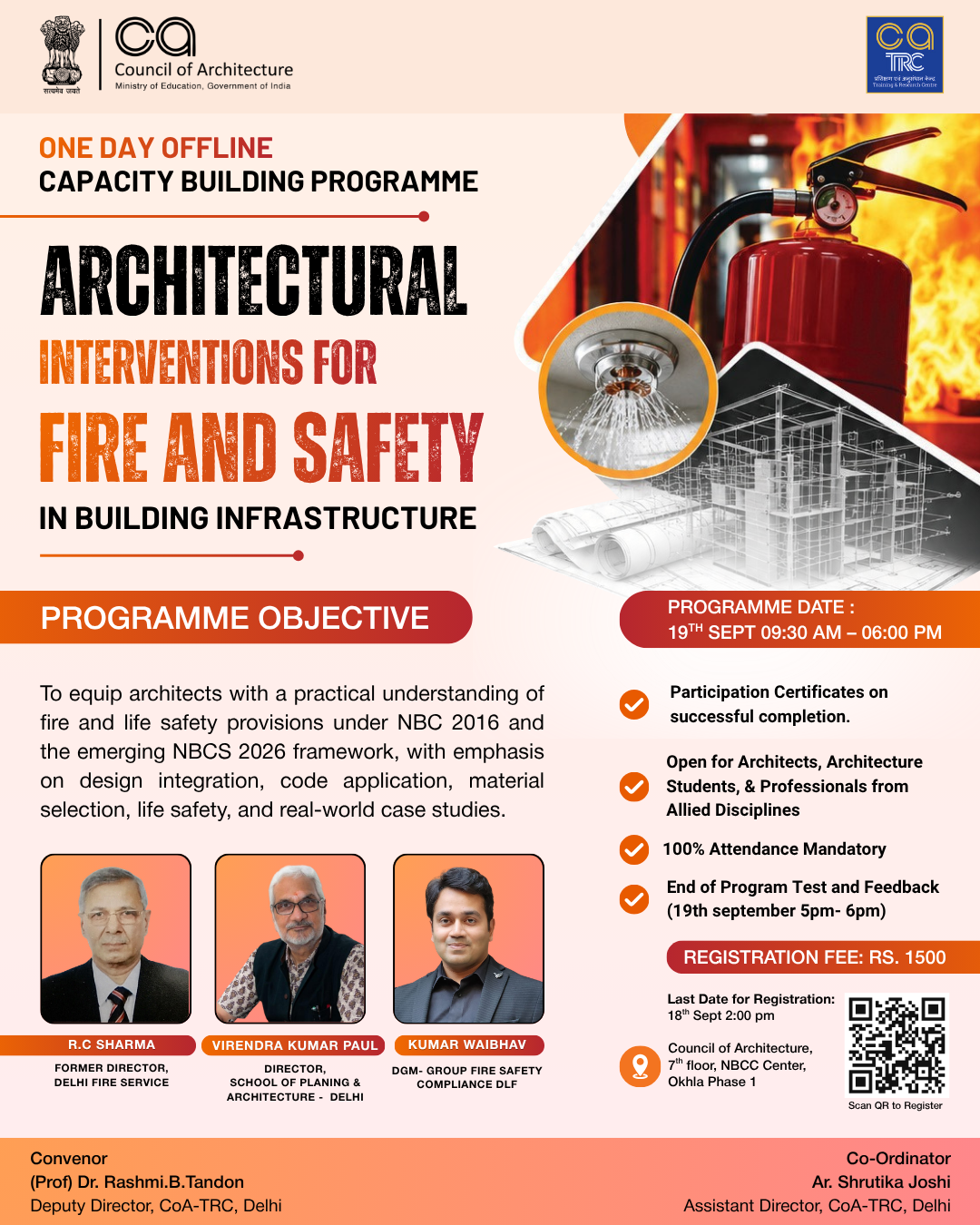
Architectural Interventions for Fire and Safety in Building Infrastructure
About TRC
About TRC
Council of Architecture Training and Research Centre (erstwhile National Institute of Advanced Studies In architecture-NIASA), the Academic Unit of Council of Architecture, was Instituted in July 2005 as the first Institute of architecture initiated jointly by the Council of Architecture (COA) and the Centre for development Studies & Activities (CDSA). It's a national level institute of Excellence that facilities advanced research in various fields of architecture to the teachers professional and individuals/students of architecture.
COA-TRC is internationally recognized as one of the foremost multidisciplinary Institutions in the field of architecture education, research, training and service. COA-TRC has been a catalyst in disseminating architecture design awareness amongst India building industry, as its graduates are active in every sphere of economic activity in the country.
Activities of COA-TRC
COA-TRC supports architects/academician/students to turn their ideas and concepts into successful competitive thoughts and provides an environment to develop essential management skills and systems that may enable architects/academician/students to grow as business leaders of tomorrow. COA-TRC thus facilitates the provision of Business Incubators for the field of architecture through its establishments, where experts from various different fields perform the function of Mentors for the Startup's incubated.
About COA-TRC
The Government of India had initiated two major campaigns, namely the Startup India initiative, and the National Mission for Skill Development. Whereas the Startup India initiative aims to boost the entrepreneurship environment in the country and to encourage startups with jobs creation, the National Mission for Skill Development has been developed to create convergence across sectors and State in terms of skill training activities.
Keeping in view these recent initiatives by the Government of India, the Council of Architecture has now decided to open up its academic and research wing through the establishment of Council of Architecture Training and Research Centres (COA-TRC) at five zones in India.
The purpose of this COA-TRC is to nurture a culture of entrepreneurship in the creative minds of young Architects and designers, so that their ideas metamorphose into newer the niftier products or services capable of being utilized commercially.
About TRC Delhi
The Training and Research Centre (TRC), Delhi, established by the Council of Architecture on 19 February 2026, is a centre of excellence dedicated to advancing architectural education, research, professional development, and policy engagement in India.
Building upon the legacy of the COA Training and Research Centre, Pune, TRC Delhi serves as a platform for fostering innovation, strengthening academia–industry collaboration, and supporting evidence-based policy initiatives. Aligned with the vision of Viksit Bharat 2047, the National Education Policy (NEP) 2020, and the quality-driven framework of the Quality Council of India (QCI), the centre aims to nurture future-ready, socially responsible, and globally competent architects.
Through research, faculty development, professional training, workshops, and collaborative initiatives, TRC Delhi promotes excellence in architectural education and practice. With a focus on sustainable development, emerging technologies, indigenous knowledge systems, and human-centred design, the centre serves as a catalyst for innovation and continuous learning across the architectural fraternity.
Activities of COA-TRC
COA-TRC supports architects/academician/students to turn their ideas and concepts into successful competitive thoughts and provides an environment to develop essential management skills and systems that may enable architects/academician/students to grow as business leaders of tomorrow. COA-TRC thus facilitates the provision of Business Incubators for the field of architecture through its establishments, where experts from various different fields perform the function of Mentors for the Startup's incubated.
About COA-TRC
The Government of India had initiated two major campaigns, namely the Startup India initiative, and the National Mission for Skill Development. Whereas the Startup India initiative aims to boost the entrepreneurship environment in the country and to encourage startups with jobs creation, the National Mission for Skill Development has been developed to create convergence across sectors and State in terms of skill training activities.
Keeping in view these recent initiatives by the Government of India, the Council of Architecture has now decided to open up its academic and research wing through the establishment of Council of Architecture Training and Research Centres (COA-TRC) at five zones in India, with Delhi as one of its Centre.
The purpose of this COA-TRC is to nurture a culture of entrepreneurship in the creative minds of young Architects and designers, so that their ideas metamorphose into newer the niftier products or services capable of being utilized commercially.
About Pune TRC
Council of Architecture Training and Research Centre (erstwhile National Institute of Advanced Studies In architecture-NIASA), the Academic Unit of Council of Architecture, was Instituted in July 2005 as the first Institute of architecture initiated jointly by the Council of Architecture (COA) and the Centre for development Studies & Activities (CDSA). It's a national level institute of Excellence that facilities advanced research in various fields of architecture to the teachers professional and individuals/students of architecture.
COA-TRC is internationally recognized as one of the foremost multidisciplinary Institutions in the field of architecture education, research, training and service. COA-TRC has been a catalyst in disseminating architecture design awareness amongst India building industry, as its graduates are active in every sphere of economic activity in the country.
Activities of COA-TRC
COA-TRC supports architects/academician/students to turn their ideas and concepts into successful competitive thoughts and provides an environment to develop essential management skills and systems that may enable architects/academician/students to grow as business leaders of tomorrow. COA-TRC thus facilitates the provision of Business Incubators for the field of architecture through its establishments, where experts from various different fields perform the function of Mentors for the Startup's incubated.
About COA-TRC
The Government of India had initiated two major campaigns, namely the Startup India initiative, and the National Mission for Skill Development. Whereas the Startup India initiative aims to boost the entrepreneurship environment in the country and to encourage startups with jobs creation, the National Mission for Skill Development has been developed to create convergence across sectors and State in terms of skill training activities.
Keeping in view these recent initiatives by the Government of India, the Council of Architecture has now decided to open up its academic and research wing through the establishment of Council of Architecture Training and Research Centres (COA-TRC) at five zones in India.
The purpose of this COA-TRC is to nurture a culture of entrepreneurship in the creative minds of young Architects and designers, so that their ideas metamorphose into newer the niftier products or services capable of being utilized commercially.
About TRC Bengaluru
The Training and Research Centre (TRC), Bengaluru, established by the Council of Architecture on 8 June 2026, is a regional centre of excellence dedicated to advancing architectural education, research, professional development, and innovation.
The centre serves as a platform for training, faculty development, research, skill enhancement, and knowledge exchange, bringing together educators, practitioners, students, and industry stakeholders to strengthen the architectural profession. Through workshops, seminars, collaborative initiatives, and capacity-building programmes, TRC Bengaluru promotes continuous learning and academic excellence.
Aligned with the Council of Architecture's vision of fostering quality, innovation, and professional growth, TRC Bengaluru supports the development of future-ready architects while contributing to the advancement of architectural education and practice across the region.
Activities of COA-TRC
COA-TRC supports architects/academician/students to turn their ideas and concepts into successful competitive thoughts and provides an environment to develop essential management skills and systems that may enable architects/academician/students to grow as business leaders of tomorrow. COA-TRC thus facilitates the provision of Business Incubators for the field of architecture through its establishments, where experts from various different fields perform the function of Mentors for the Startup's incubated.
About COA-TRC
The Government of India had initiated two major campaigns, namely the Startup India initiative, and the National Mission for Skill Development. Whereas the Startup India initiative aims to boost the entrepreneurship environment in the country and to encourage startups with jobs creation, the National Mission for Skill Development has been developed to create convergence across sectors and State in terms of skill training activities.
Keeping in view these recent initiatives by the Government of India, the Council of Architecture has now decided to open up its academic and research wing through the establishment of Council of Architecture Training and Research Centres (COA-TRC) at five zones in India, with Bengaluru as one of its Centre.
The purpose of this COA-TRC is to nurture a culture of entrepreneurship in the creative minds of young Architects and designers, so that their ideas metamorphose into newer the niftier products or services capable of being utilized commercially
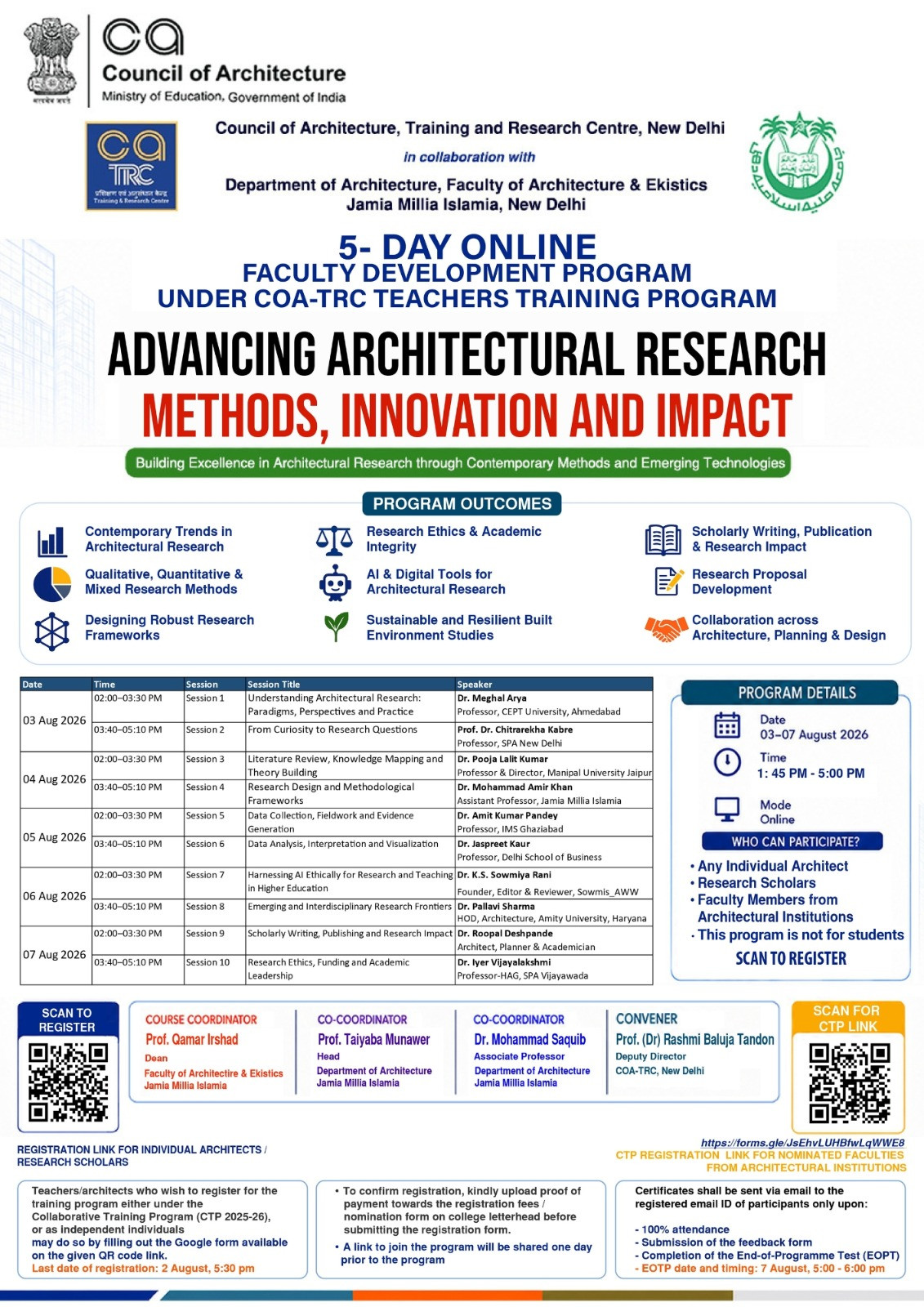
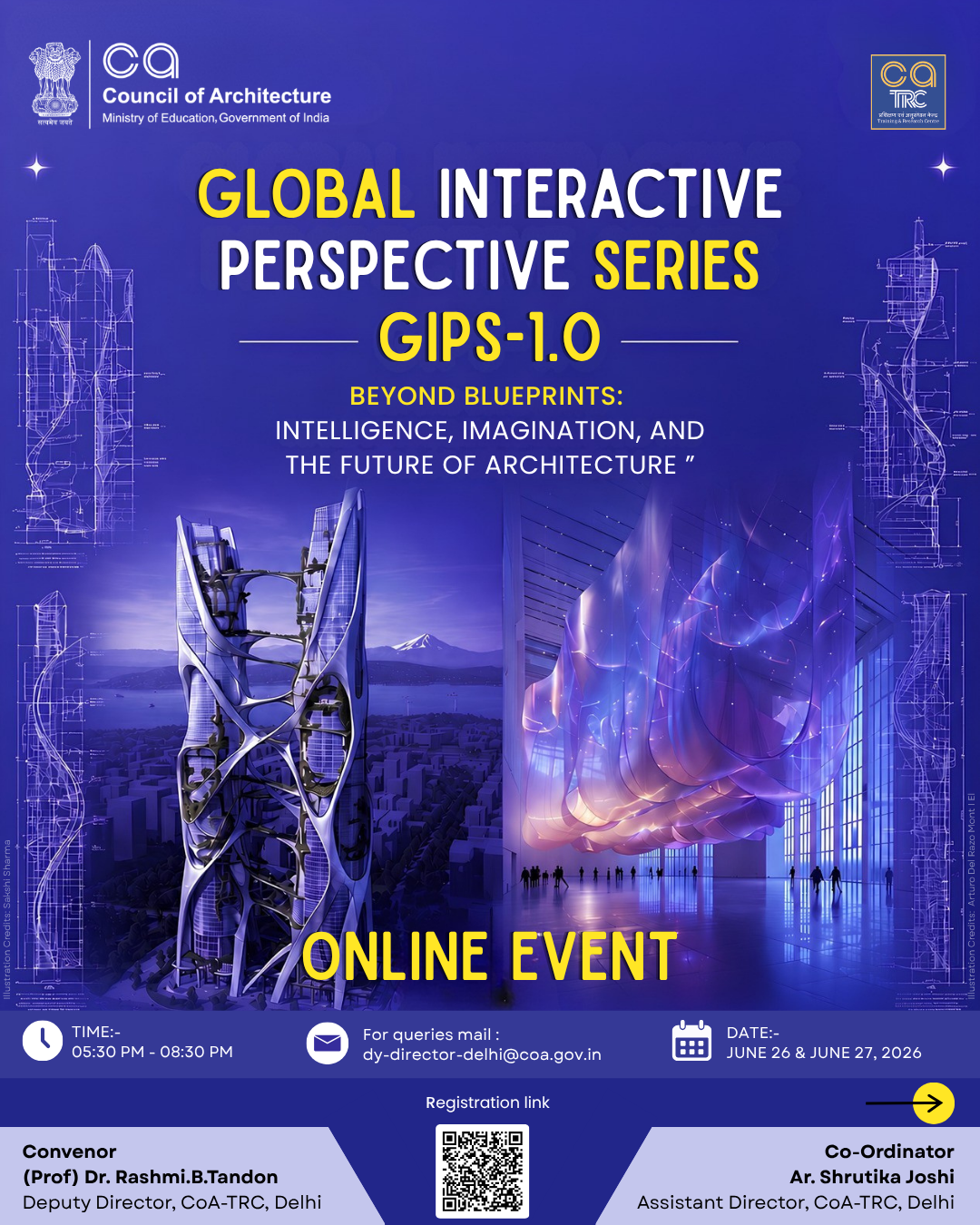
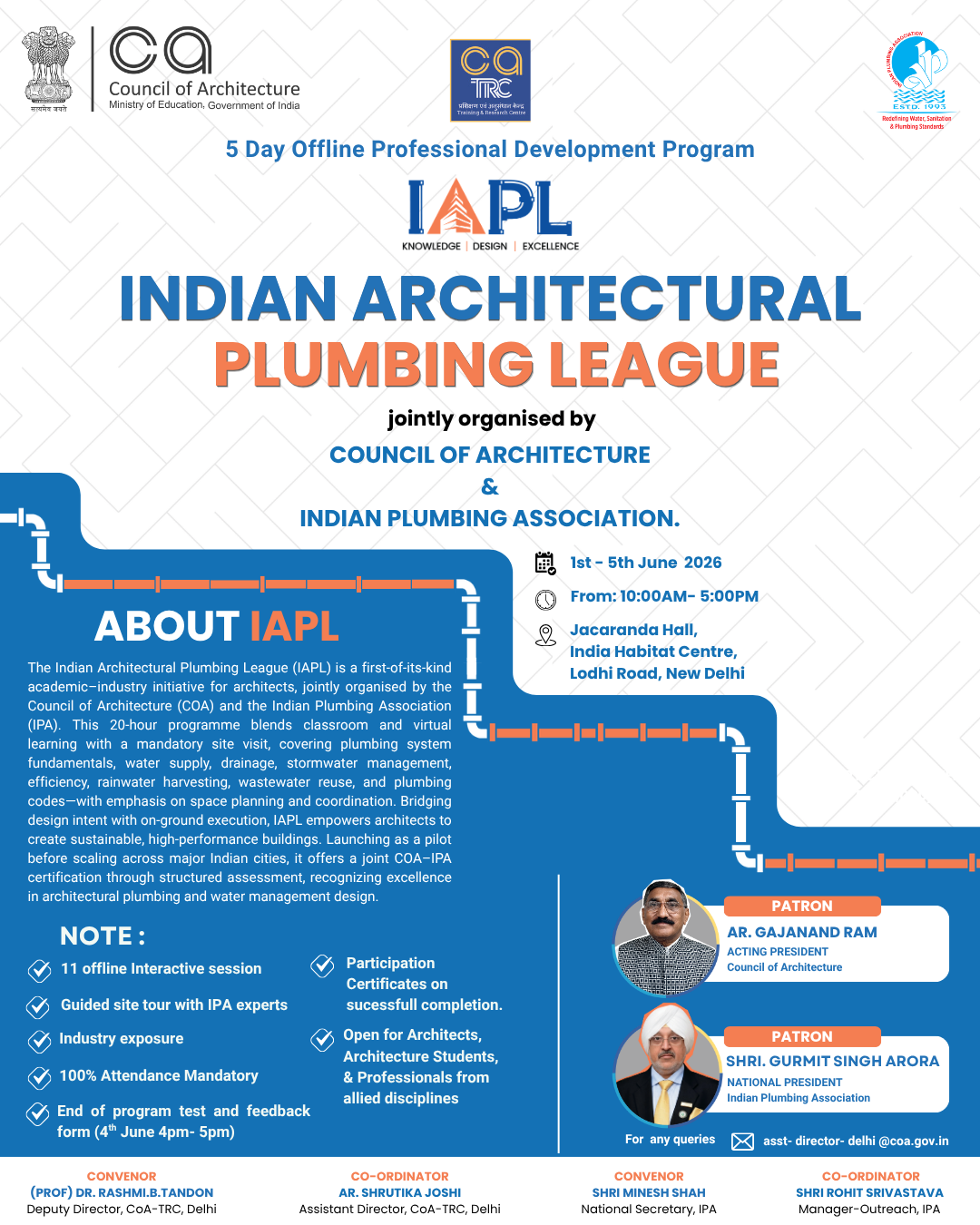
LEARN ANYTIME, ANYWHERE
Enjoy our free online courses, wherever you are and whenever you want. Access course content on mobile, tablet or desktop.